Simón LevyWashington D.C.Updated November 14, 2026Cónsul →ESEN
APEC Summit · Shenzhen · November 19
A Table for Three
Trump, Xi and Putin sit down alone in Shenzhen. Brazil and Mexico get the bill from outside the room
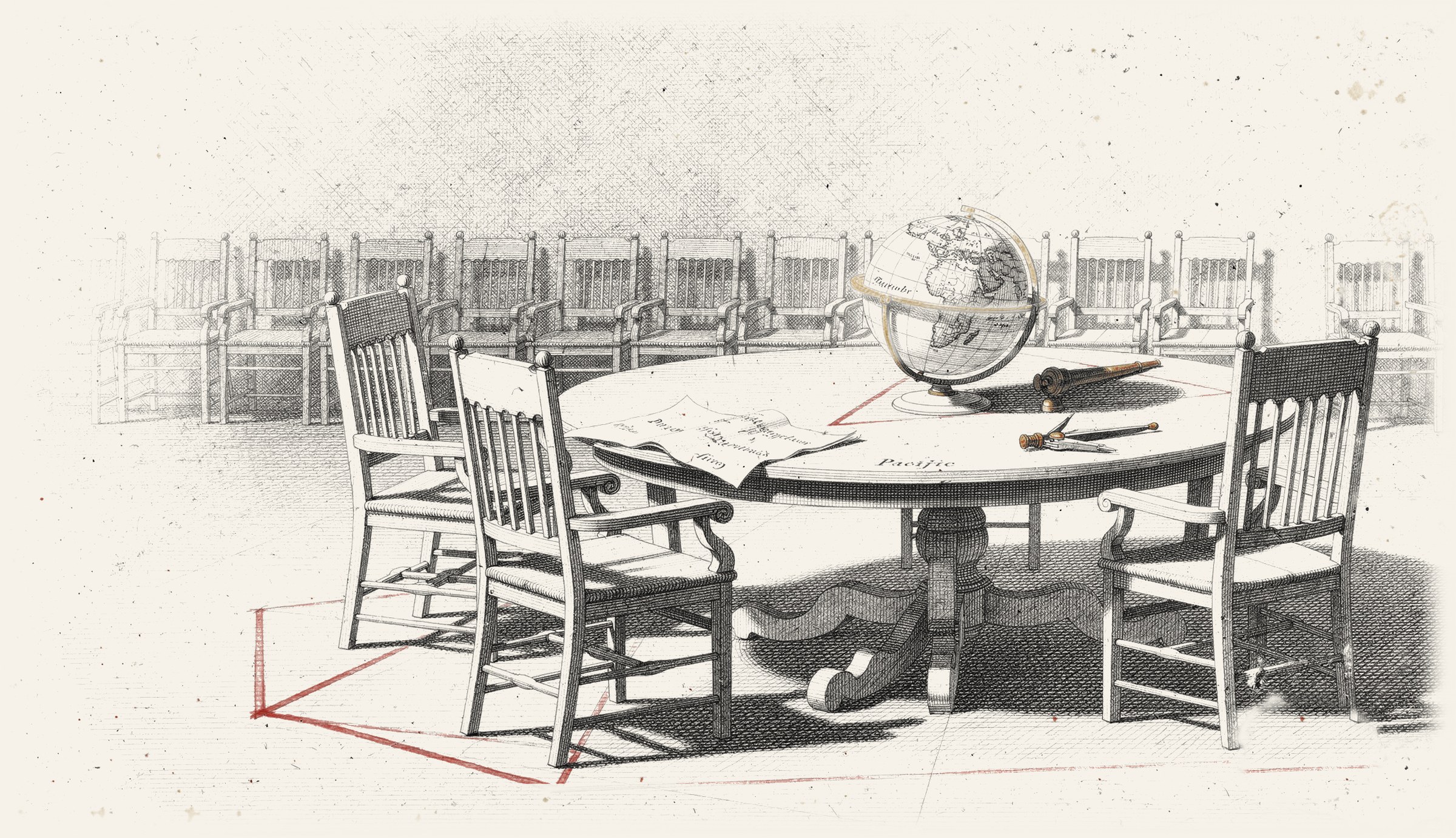
Plate I · One table, three chairs. The rest were pushed against the wall.
On Thursday, November 19, in Shenzhen, the three men who control nearly every nuclear weapon on the planet sit at the same table for the first time.
Europe is not there. Ukraine is not there. Brazil is not there. Mexico will be in the same city, with no meeting with Trump.
What is really being negotiated? Why did Putin propose it? How did Trump end up dealing with the two owners of BRICS while taxing Brazil? My answer: Trump did not destroy BRICS. He took the seat at the head of its table.
Simón Levy · Washington D.C. · November 14, 2026
Cashback · Es Posible
Want to be a partner in this complaint through cashback and earn 40% of what it raises?
Putin and Xi have met more than 40 times since 2013. Trump and Xi, eight. Trump and Putin, seven; the last one in Alaska, in August 2025. All three at the same table, zero. The White House confirmed it on November 13: it will take place on the sidelines of the APEC summit, there will be no one-on-one between Trump and Putin, and there will be one between Trump and Xi.
I am writing this on my way to Shenzhen, and there is one fact I cannot get out of my head.
The idea did not come from Washington or from Beijing. Putin proposed it. On October 9 he called Trump, and two things came out of that call: the deal for Russia to sell diesel to the world and the proposal to sit down with Xi. Moscow raised it with Beijing through diplomatic channels. China answered that it would not object if Trump agreed. Of the three, the host was the least convinced.
The weakest man at the table is the one who called it.
To me, that is the first clue to what this meeting is for.
The table, built in code. Drag to turn it.
Officially there are two topics: warheads and Iran. Trump wants to talk about cutting nuclear weapons and about the Iran war. His own team says it expects no agreement and calls it "the first conversation".
So the photo is the result. Three chairs, no signed paper, and the whole world watching who was not invited.
And there is one topic each side tells differently. Washington says Ukraine is off the table. Yuri Ushakov, the Kremlin aide, said on November 12 that Putin and Trump will keep negotiating an end to the war in Shenzhen. It is the same meeting, told two ways. Someone is not saying everything, and Zelensky has already warned that he fears a deal behind Kyiv's back.
Eight chairs were left against the wall: Ukraine, Europe, Japan, South Korea, Taiwan, India, Brazil and Mexico. All of them will be discussed. None of them gets a seat. South Korea's foreign minister, Cho Hyun, asked to avoid a "second Yalta". The Kremlin rejected the comparison: it says nothing agreed in Shenzhen can be imposed on anyone.
Two of those chairs matter most to me, Brazil's and Mexico's. And one question almost nobody is asking: how did Trump end up dealing with the two owners of BRICS while he punishes their partners.
·
It took thirteen months to get to this table.
It started with soybeans and rare earths. On October 30, 2025, in Busan, Trump and Xi paused their trade war. The average tariff on China dropped from 57% to 47%, China released its rare earths and promised to buy 25 million metric tons of American soybeans a year through 2028. Since then they have met in Beijing, in May, and in Washington, in September. Shenzhen is the third time this year. Miami will be the fourth.
Then came the year without rules. In February 2026, New START expired, the last treaty capping American and Russian warheads. Trump refused a one-year extension: he wants a new one that includes China. For the first time in more than 50 years, the two largest arsenals on earth have no limit. And on February 28 the Iran war began, closing the Strait of Hormuz and sending oil up.
In October, Trump turned. Put the dates side by side. On September 18 he signs the Graham bill, with new sanctions on Russia and Iran. On October 9 he strikes a deal with Putin for more than 4 million tons of Russian diesel for the world market, and Treasury suspends sanctions on that diesel until April 2027. On October 16 he signs an order that triggers the Graham sanctions and suspends them in the same act.
The midterms were 18 days away and diesel was up almost 70%.
Then the voters spoke. On October 25, Lula won a fourth term in Brazil. On November 3, Democrats won the House and the Senate. Trump arrives in Shenzhen with two years left and a hostile Congress starting in January. That is why he needs results abroad. Xi and Putin know it.
·
Now the warheads, which are the official topic.
According to SIPRI, Russia has 5,420, the United States 5,042 and China 620. There are 12,187 in the world, and Russia and the United States hold about 83% of the usable ones. Deployed today, mounted on missiles: Russia 1,796, the United States 1,770, China 34.
Total inventoryUsableDeployed
Three arsenals, to scale. Move the slider to 2030 and see how far China still has to go.
Asking China to sign a cap today is asking it to accept third place in writing. It will not. China could pass 1,000 warheads by 2030 and would still have about a quarter of what each of the other two holds now. Beijing says its arsenal is far smaller and that it will not negotiate until it nears parity.
If nobody expects a nuclear deal, the topic is there for something else.
The warheads are the pretext.
It is the only subject that justifies a table with room for just three. No other topic leaves out Europe, India and Brazil without anyone having to explain why.
·
What really brought Trump to the table was a strait.
At the end of January, Brent closed at $70.69 a barrel and a fifth of the world's oil moved through Hormuz. On February 28, Israel and the United States struck Iran, and Iran closed the strait. Since then Brent has swung between roughly $70 and $120. There was a ceasefire in April and another, of 60 days, in June, brokered by Pakistan. It expired in August with no peace deal.
Nine months later it is still nearly shut. Transits through Hormuz are about 65% below normal, and October saw more incidents against ships than any other month of the war. On November 12, Trump said he does not need a deal with Iran. Brent closed that day at $95.82.
Who can open that door? China is the big buyer of Iranian oil. Russia is its strategic partner. Iran is a BRICS member, and its president was at the New Delhi summit, next to Xi and Putin.
Trump is going to ask the two bosses of BRICS to help him close his war. That favor has a price.
·
And here is what I see and almost nobody is saying.
BRICS has eleven members. In September they met in New Delhi and signed a 140-paragraph declaration that does not mention the United States once. Lula did not go; he was campaigning. When the summit ended, China took the chair of the bloc for 2027.
Two founders got punishment from Trump. In 2025 he threatened a 100% tariff on anyone abandoning the dollar and an extra 10% on anyone aligning with BRICS. Brazil and India got the highest tariffs that year, 50%. Today Trump's tariffs hit 47.3% of what Brazil sells to the United States.
The other two got business. China: a trade truce, a state visit to Washington and four meetings in one year. Russia: diesel free of sanctions until April 2027, the Graham law suspended and, under review, the lifting of sanctions on its sovereign fund, the RDIF.
Trump punishes the junior partners and deals with the owners.
On November 19 he sits down with the country that chairs BRICS in 2027 and with Russia, another founder. Without Brazil. Without India. Without South Africa. Whatever is said there about oil, sanctions and currencies will weigh more than the 140 paragraphs of New Delhi. That is how you walk into a club without asking for membership.
Trump is already inside BRICS. He came in from the top.
·
Brazil won an election and lost its chair.
Its biggest business depends on China. In 2025 it sold China 85.4 million tons of soybeans, 79% of everything it exported. So far in 2026 it is at almost 64 million.
But China promised Trump it would buy at least 25 million tons from American farmers every year, from 2026 through 2028. And in September, while Trump and Xi were negotiating in Washington, Chinese buyers slowed their purchases of Brazilian soybeans. Every ton China promises Trump is a ton of leverage Brazil loses. The risk, as I see it, is that China buys even more to please Trump before the truce expires on January 10.
With diesel the story is almost a joke. After Trump's deal with Putin, Russia doubled its exports: from 135,000 to 271,000 barrels a day in October. Not a single cargo had reached the United States. Shipments to Brazil and Turkey did go up. Brazil buys fuel from the partner Trump forgives, and pays tariffs by decision of the same Trump.
Lula won on October 25. A day later Trump had not congratulated him. After the Republican defeat in the midterms, Lula told his people it was time for Trump to take Brazil seriously, and his foreign minister, Mauro Vieira, spoke with Marco Rubio in Atlanta.
But the table where its soybeans and its diesel get decided is in Shenzhen. And Brazil has no chair there.
·
Mexico will be in Shenzhen. Through another door.
Claudia Sheinbaum travels to China from November 15 to 20 with Foreign Minister Roberto Velasco, Marcelo Ebrard, Alicia Bárcena and Rosaura Ruiz. She will meet Xi Jinping, her first meeting on Chinese soil. There will be no meeting with Trump in China. She said herself that, if it happens, it will be at Mar-a-Lago, during the G20 in December.
Ebrard said that at the APEC Business Advisory Council session only two leaders will speak: Xi and Sheinbaum. Mexico hosts APEC in 2028. That is the photo Washington will study closely: the president of Mexico, alone on stage with Xi.
And the timing is bad. On July 1, the United States declined to extend the USMCA for another 16 years. The treaty stays in force until 2036, but it is now reviewed every year, and one of the sensitive points is Article 32.10, the clause on dealings with non-market economies. It was written with China in mind.
Mexico has already paid in advance. Since January 1 it charges tariffs of 5% to 50% on 1,463 tariff lines; the 50% falls on cars, auto parts and steel. China answered: it declared those tariffs trade barriers and since August has charged duties of 17.8% to 51.6% on Mexican pecans. Mexico's trade deficit with China in 2025 was $123 billion.
Mexico raised tariffs on China to protect the USMCA. And a week before his own truce expires, Trump can lower his tariffs on China. Ebrard has said it since 2025: Mexico will adjust its tariffs to whatever the United States and China agree.
Mexico's trade policy gets decided at a table where Mexico does not sit.
·
Three things can come out of that room.
The first is the one the White House itself announces: a photo and nothing else. Three leaders, a handshake, zero documents. Even so, it moves things. Putin leaves isolation, Xi presents himself as host to the world, and America's allies wonder what its guarantee is worth.
The second is a joint sentence. It is the most Brookings analysts see as possible: shared principles. That a nuclear war cannot be won. That sea lanes must stay open. It sounds like little, but "open sea lanes" signed by all three is a direct message to Tehran, and it brings oil down.
The third is the grand bargain, the one Kyiv, Seoul and Brussels fear: that behind closed doors Ukraine is traded for Iran, sanctions for oil, Taiwan for soybeans. The analysts themselves think it unlikely. But the Kremlin has already said Ukraine will be discussed.
I ran all three. In none of them does Brazil's position improve, or Mexico's.
·
I am not going to stand there looking at the photo.
There are five files I am taking to Washington.
The first is the diesel. Treasury's General License 135 authorizes imports of Russian diesel until April 7, 2027. But a 2022 statute, the Ending Importation of Russian Oil Act, bans imports of Russian energy products, and an administrative license does not repeal an act of Congress. Democratic lawmakers have already asked several banks to preserve the records of those transactions.
The second is the Graham law. It orders 100% tariffs on purchases of Russian energy and on the five countries that do the most to help evade the oil sanctions. Trump triggered all of it and suspended it in the same order, citing the "national interest". The question for the Congress that takes office in January is simple: who are those five countries, and who decided to let them off.
The third is the Russian fund. The Trump administration is reviewing a request to remove the Russian Direct Investment Fund, the RDIF, from the sanctions list. Its chief, Kirill Dmitriev, is also Putin's envoy, and he promotes the fund as the channel to collect payment for the diesel cargoes.
The fourth is Mexico and Article 32.10. The USMCA requires three months' notice if a partner negotiates a trade agreement with a non-market economy, and it lets the other two walk away. Mexico is not negotiating a treaty with China. But in September it signed a scientific memorandum on artificial intelligence, supercomputing and robotics. Every paper signed in Shenzhen will be read in Washington with that clause in hand.
The fifth is Brazil. If Russian diesel cargoes grew toward Brazil under a United States license, there are banks, insurers and shipping companies that touched the American financial system. I am putting that before Treasury to investigate: who got paid, which bank it went through, and whether the money ended up with sanctioned entities.
·
The clock is already running.
Trump leaves Washington on Monday the 16th for the Philippines, for the ASEAN meeting, and flies from there to Shenzhen. Elon Musk travels with him but does not go into the meeting.
December 14 and 15 is the G20 in Miami: the fourth Trump and Xi meeting of the year, and where Sheinbaum's meeting with Trump could happen. Putin is invited; the Kremlin says his trip depends on what happens in Shenzhen. On January 10 the trade truce between the United States and China expires. If it is not extended, the high tariffs and China's rare earth controls come back, the same month the Democratic Congress is seated. On April 7 the Russian diesel license expires. On July 1 comes the next annual USMCA review.
On Thursday I will update this piece with whatever comes out of the room.
Three chairs. Eight against the wall.
Our future gets decided there. And we are not seated.
Simón Levy · Washington D.C. · November 14, 2026
Notes and sources
The meeting and its agenda: White House, November 13, 2026; U.S. official cited by Reuters and NBC News; meeting count by the Associated Press. Putin's proposal: Reuters, October 18, 2026; Yuri Ushakov, October 25 and November 12, via Interfax. Zelensky: Al Jazeera, November 14. Cho Hyun, South Korea's foreign minister, November 13; Dmitry Peskov, Kremlin spokesman.
Busan truce and soybeans: S&P Global, September 24, 2026; Brookings, November 12; U.S. Treasury. New START and the Iran war: Al Jazeera and the UN Security Council, November 2026. Russian diesel, the Graham law and the RDIF: CNBC, October 9; Newsweek and NBC News, October 16 and 17; CNN and the Atlantic Council, October 29. Warheads: SIPRI Yearbook 2026, estimates as of January 2026. Hormuz and Brent: UK Maritime Trade Operations, via the UN; CBS News, November 2; CNBC, November 12.
BRICS: 18th Summit, New Delhi, September 12 and 13, 2026; CNN Brasil. Tariffs on Brazil: Ministry of Development, Industry, Trade and Services, via Folha de S.Paulo, November 6. Soybeans: Times Brasil, May 2026; Aprosoja-MT, November 2026. Diesel to Brazil: Financial Times with Kpler data, via Meduza, November 12. Lula: Economic News Brasil, October 26.
Mexico: Sheinbaum press conference, November 12, 2026, via EFE; Marcelo Ebrard, via Mexico News Daily. USMCA: USTR, July 1, 2026; BBVA Research, July 2; treaty text, Articles 32.10 and 34.7. Tariffs: Diario Oficial de la Federación, December 29, 2025; China's Ministry of Commerce; Banxico. Scientific memorandum: Secihti, September 2026.
These are my own reading, and should be read that way: that the weakest man called the table, that the warheads are the pretext, that Trump entered BRICS from the top, the risk to Brazil's soybeans, the three outcomes and the five files. The accounts on Ukraine conflict: Washington says it is off the table, the Kremlin says it is on.
 Es Posible